

Photon Rain and Energy Tanks: Why the New 2026 Battery Rebate Just Made Your Solar Size Matter More Than Ever
Picture this: it rains photons
Your battery is an Energy Tank. When the sun shines, photons rain on your roof and fill the tank. When it doesn’t, the tank just sits there, draining into the house all night.
That’s the whole game.
A battery is not a power source. It’s a bucket. The roof is what fills it. And if the roof can’t catch enough rain on a grey Canberra Tuesday in July, it doesn’t matter how big your tank is — you’re back on the grid by 10pm.

Two rules fall out of this:
- A big tank with a small roof is a waste of money. You’ll never fill it.
- A big roof with a leaky house is also a waste. You’ll fill the tank and watch it drain into bad insulation and a resistance hot water tank by morning.
Your house should be an esky. Your roof should be a downpour catcher. Your battery is just the bit in the middle.
What changed on May 1
The federal Cheaper Home Batteries Program didn’t end. It got tiered. As of today, the rebate is generous on the first 14 kWh of battery, mediocre on the next 14, almost nothing after that, and zero past 50.
The STC factor dropped from 8.4 to 6.8 on May 1, and it’ll keep dropping every six months until the program winds up at the end of 2030. The administrative detail lives on the Clean Energy Regulator’s solar batteries page if you want the bedtime reading.
📋 What’s an STC factor?
STCs (Small-scale Technology Certificates) are how the federal government delivers the rebate. Each kWh of approved battery generates a number of STCs, and STCs trade on a market for roughly $36–$40 each.
The STC factor is the multiplier — how many STCs you get per kWh of battery. Higher factor = bigger rebate.
When you hear “the rebate dropped,” what actually changed is the multiplier: 8.4 → 6.8, which translates to roughly $244–$272 per kWh instead of $300+ per kWh under the old rate. The factor steps down again every January and July until 2030, when it hits zero.
You don’t have to deal with STCs yourself — your installer claims them and discounts your invoice accordingly. But if you want to verify the maths on a quote, the REC Registry STC calculator is the official tool.
In rough numbers:
- 10 kWh: ~$2,440 rebate (~$244/kWh)
- 14 kWh: ~$3,400–$3,700 rebate (~$244–$264/kWh — the new sweet spot)
- 20 kWh: ~$4,920 rebate (~$246/kWh average - still not bad)
- 28 kWh: ~$6,000 rebate (~$214/kWh average - still not bad)
- 40 kWh: ~$6,430 rebate (~$161/kWh average - falling off a cliff)
- 50 kWh: ~$6,000–$7,000 (~$120–$140/kWh average — down from ~$16,650 30th April 2026 at a flat $333/kWh)
Translation: The government is paying you to install the size of tank a normal household actually uses, and is no longer subsidising people building a private power station.
One important wrinkle — the rebate rate is based on your commissioning date, not the date you signed the contract or paid your deposit. The CER spells this out here. If an installer promised you a pre-May commissioning and missed it, that’s an ACCC matter, not just a “sorry mate” matter.
The average Aussie home
A typical detached home with two people uses 12–25 kWh per day. Add ducted aircon, electric hot water, a pool, or an EV and you’re staring at 40–50 kWh/day in a Canberra winter without breaking a sweat.
Of that, maybe a third happens overnight — the bit a battery actually has to cover.
Solar system sizes have crept up nicely. A decade ago people were putting 5 kW on the roof. Today 13.2 kW is bog-standard and 20 kW is increasingly common where the roof allows it. That’s not vanity — that’s people finally working out that on a cloudy day, a small roof produces almost nothing, and in a Canberra winter “almost nothing” is the default setting for weeks at a time. If you want to see what your specific suburb actually generates across the year, the APVI Solar Map is the honest answer.
Use it, store it, or lose it. But first, you have to catch it.
The three tiers (and the battery to match)
These are starting points, not gospel. Your roof, your usage, your phase configuration, and your DNSP all push the numbers around. But this is the shape of it:
Tier 1: Standard Single-Phase Home
~10 kW of panels on an 8 kW inverter, paired with a 10–14 kWh battery.
For most homes with normal usage (15–25 kWh/day), gas still on, no EV. The 14 kWh battery hits the rebate sweet spot. The panels are oversized vs the inverter (normal — panels rarely hit nameplate), and you’ll fill the tank on most sunny days.
Tier 2: All-Electric or EV Household
~15 kW of panels on a 10 kW inverter, paired with 14–20 kWh of battery.
For homes electrifying off gas, running a heat pump, or charging an EV at home. Daily load probably 25–40 kWh. You need a bigger roof to catch enough on cloudy days, and a battery that can carry overnight EV charging or a winter morning’s heat pump load. 20 kWh still gets a useful slice of rebate.
Tier 3: Three-Phase, High-Use, Future-Proofed
~20 kW of panels on a 13–15 kW three-phase inverter, paired with 20–28 kWh of battery.
For three-phase homes with ducted aircon, EV(s), pool, electric hot water, working from home — the lot. Daily load 35–50+ kWh. Three phases lifts the inverter ceiling and means a blackout doesn’t drop your ducted aircon. Going past 28 kWh of battery now needs a damn good reason because the rebate falls off a cliff.
Don’t size the battery before fixing the leaks
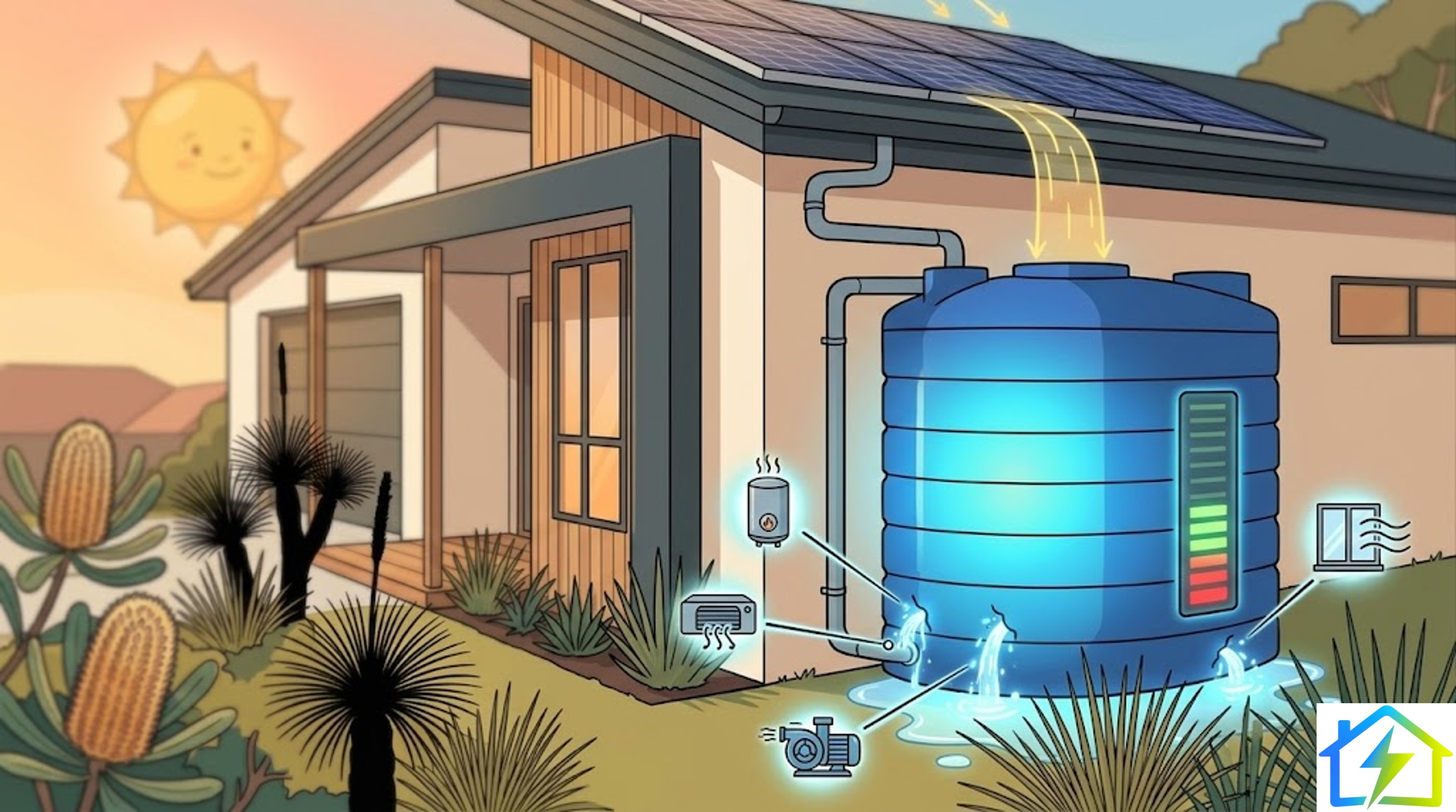
A 14 kWh tank into a leaky house is a 7 kWh tank by sunrise. Before spending tens of thousands on storage, the cheaper wins are usually:
- Hot water on a heat pump and a timer. A resistance tank is a slow leak.
- Insulation, draught sealing, decent curtains. Your house should be an esky.
- A reverse-cycle aircon you actually use instead of a gas heater.
- Pool pump on a timer that runs during the photon shower, not at 2am.
If it heats, it eats. Plug the leaks first, then size the tank.
Canberrans — the ACT Sustainable Household Scheme offers up to $15,000 in zero-interest loans for exactly this kind of work, and stacks with the federal battery rebate.
The “install solar like batteries don’t exist” rule still holds
Even if you’re not buying the battery today, make sure your installer doesn’t install your solar like batteries don’t exist.
That means:
- Don’t undersize the roof. A 5 kW system “ready for a battery later” can’t refill a battery in winter. You’ll have a tank you can’t fill.
- Get a hybrid inverter, or at least know what you’ll do at battery time. Retrofitting an AC-coupled battery onto a string inverter works, but it’s less efficient and the wiring decisions get made twice.
- Three-phase houses: don’t put a single-phase inverter in. You’ll regret it the first time the grid drops out and only a third of the house has power.
Two checks worth doing yourself before you sign anything:
- The battery is on the Clean Energy Council’s approved batteries list. If it’s not, no rebate.
- The installer holds Solar Accreditation Australia accreditation for grid-connected battery systems. If they don’t, also no rebate, and you’re a guinea pig.
For broader background, the federal government’s Solar Consumer Guide is the official independent explainer and is worth a skim.
Phase 1 takeaway
- The rebate now rewards 14 kWh batteries and punishes monster stacks.
- The size of your roof matters more than ever — a battery without enough panels is a tank in a drought.
- Most homes want 10–15 kW of panels and 14 kWh of battery. Bigger only if your usage genuinely warrants it.
- Fix the leaks before you buy the tank.
- If you’re getting quotes, ask the installer what size the panel array would need to be to refill the battery on a Canberra winter day. Watch them squirm.
Saving Money, Saving Energy. Same as it ever was — the maths just changed.

Want personalised advice?
Get a free energy review tailored to your home — no products, no commissions.
Get free review