
The Bright Sparks Dictionary: Plain-English Terms for Solar, Batteries, EVs and Home Energy
If you’ve ever nodded along to an installer’s quote while quietly Googling “what is a kilowatt?” or “what is a hybrid inverter?”, this post is for you.
Home energy jargon isn’t complicated once someone explains it plainly. The problem is that most of the people using it have a financial interest in you not asking too many questions.
Here’s the Bright Sparks version.
Quick index
Units: Volt · Amp · Watt / Kilowatt · Kilowatt-hour · kVA
A–C: Abolishment vs disconnection · AC charging vs DC charging · AC-coupled vs DC-coupled · All-electric home · Bidirectional charging · Black start · CCS2 · Charge scheduling · Consumption monitor · COP · Controlled load
D–H: Degradation rate · Demand tariff · Depth of discharge · Double glazing · Draught proofing · Electrification · EVSE · Feed-in tariff · Heat pump · Hybrid inverter
I–N: Induction cooktop · Inverter · Level 1 / Level 2 / DC fast charging · LFP · Microinverter · MPPT · NMC · NMI · Nameplate vs usable capacity
O–R: Onboard charger · PV / Photovoltaic · R-value · Racking / Mounting · Resistive heating · Reverse cycle air conditioning · Round-trip efficiency
S–T: SAA · Self-consumption · Single-phase vs three-phase · Smart charging · SRES · STC · Star rating · State of charge · String inverter · Sustainable Household Scheme · Temperature coefficient · Throughput warranty · Throttling · Tier 1 · Time-of-use tariff · Type 2 connector
V–W: V2H · V2L / V2G / V2H / V2X · VPP · Wall connector
⚡ Units first — volts, amps, watts and watt-hours
Before anything else, let’s sort out the units. These come up constantly and the differences matter.
Volt (V)
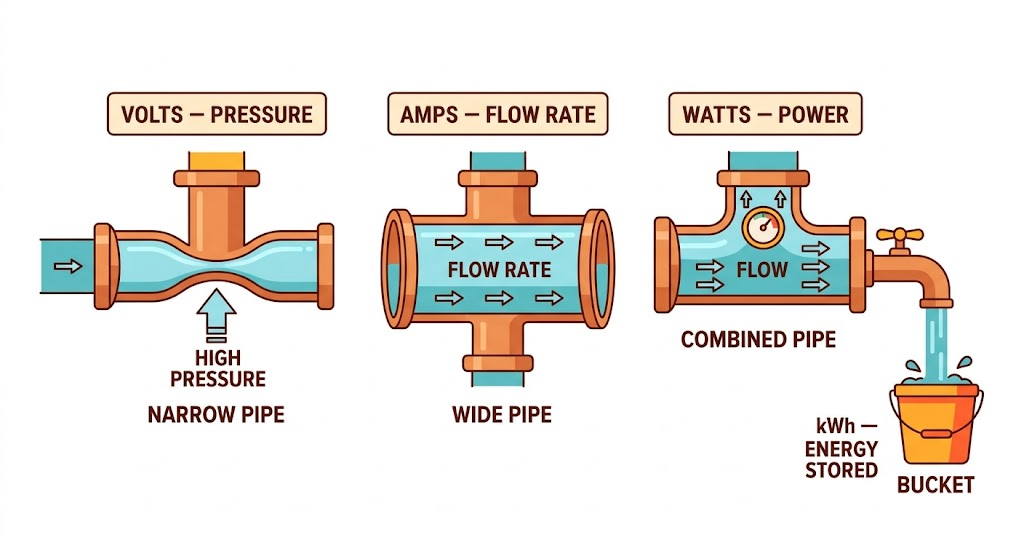
The pressure that pushes electricity through a circuit. Think of it like water pressure in a pipe. Household power in Australia runs at 230V AC. EV batteries operate at much higher voltages (often 400V or 800V DC) — part of why they charge faster than your phone.
Amp (A) / Ampere
The flow rate of electricity — how much current is moving through a wire at any moment. Think of it as the width of the pipe. A standard household circuit is typically 10A or 20A. EV chargers and battery systems often need dedicated higher-amperage circuits.
Watt (W) / Kilowatt (kW)
Power — the rate at which energy is being used or generated right now. One kilowatt = 1,000 watts. A 5 kW solar system can produce up to 5 kW at peak. A kettle uses around 2.4 kW while it’s boiling.
Kilowatt-hour (kWh)
Energy — the total amount of electricity used or generated over time. If your 5 kW solar system runs at full output for four hours, it’s produced 20 kWh. Your electricity bill is charged in kWh. Battery storage is measured in kWh.
Put simply: kW is the speed. kWh is the distance travelled.
kVA (Kilo-Volt-Ampere)
A measure of total electrical capacity — similar to kW but accounting for the quirks of AC power. Network operators use it to set limits on how large a solar system can be on your connection. Your installer deals with this; you just need to know it exists if it comes up in an approval letter.
⚡ AC and DC — the two types of electricity
This distinction runs through almost everything in home energy, so it’s worth getting clear on before the A–Z.
AC (Alternating Current)
The type of electricity that flows through the grid and powers your home. In Australia it runs at 230 volts and 50 Hz — the current reverses direction 50 times per second. That rapid alternation is what makes it efficient and safe to distribute across long distances and into homes.
DC (Direct Current)
The type of electricity that solar panels produce and batteries store. It flows in one direction only. DC is well suited to generation and storage, but less practical for distributing power across a grid network.
Why this matters: conversion losses
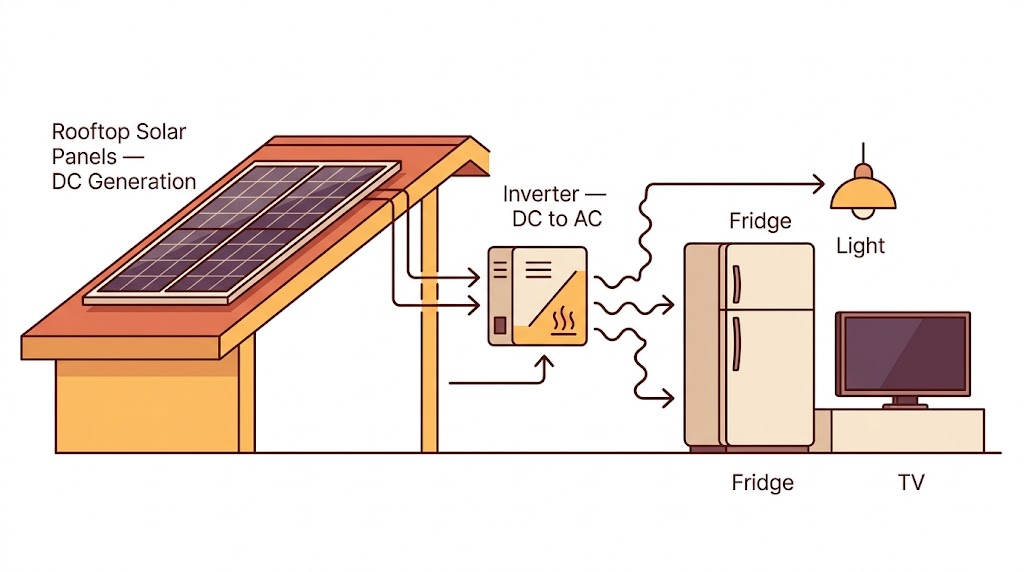
Every time electricity is converted between AC and DC, a small percentage is lost as heat. Solar panels produce DC — the inverter converts it to AC for your home. If you’re charging a battery, it converts back to DC for storage, then to AC again when you use it. Each conversion costs you a few percent.
This is why system design matters. A well-designed setup minimises unnecessary conversions — it’s the core argument for DC-coupled batteries over AC-coupled ones, and why a properly designed hybrid system beats a cobbled-together retrofit.
📖 A–Z
Abolishment vs disconnection (gas)
Two different things that sound the same. Disconnection temporarily stops gas supply to your property but leaves the infrastructure in place — and in many cases you still pay a daily supply charge. Abolishment permanently removes the gas connection. If you’re going all-electric, abolishment is what stops the fees for good. Worth clarifying with your gas retailer before you assume disconnection has sorted it.
AC charging vs DC charging (EVs)
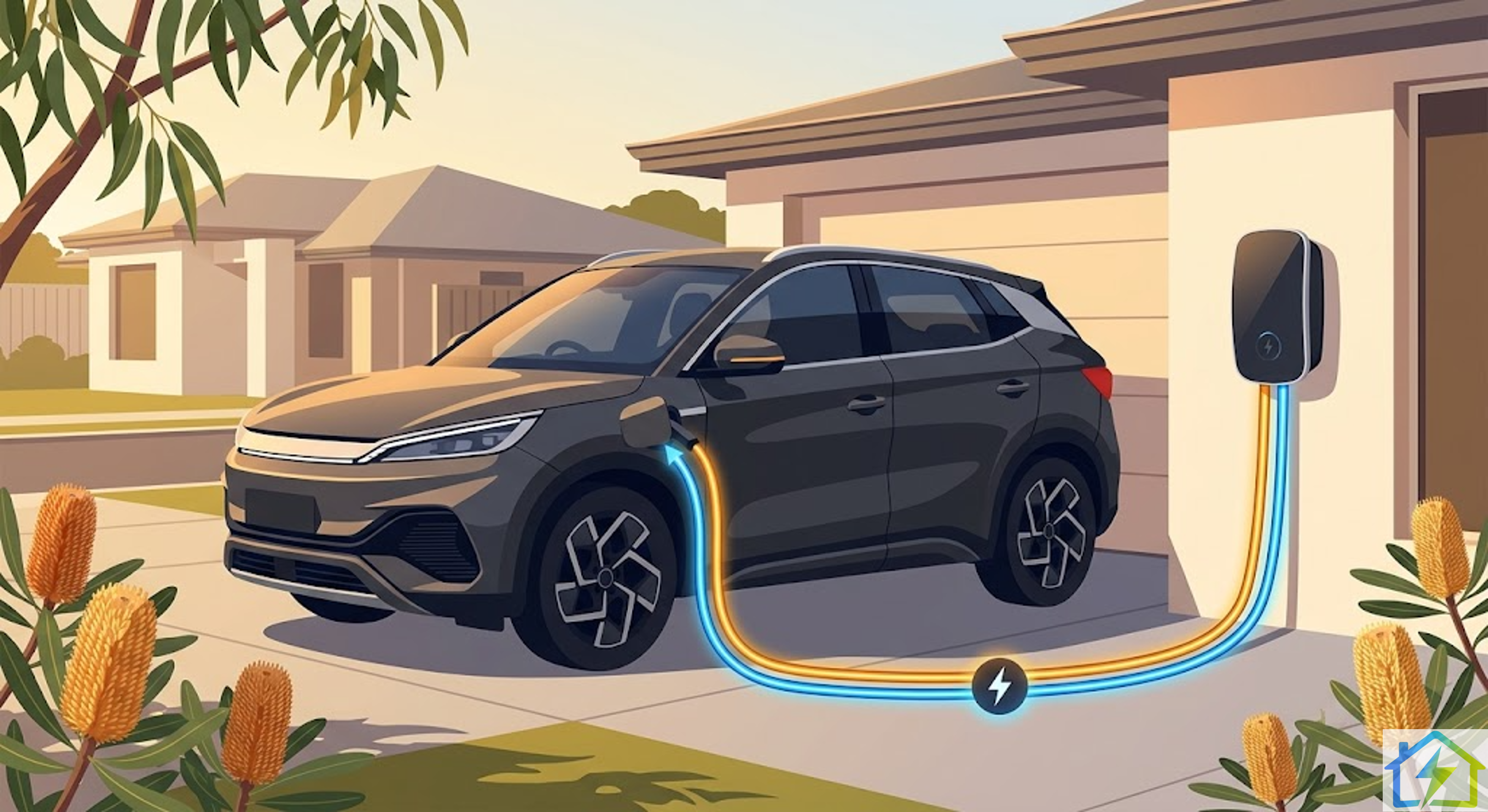
AC charging is what happens at home — your car’s onboard charger converts the AC from your wall into DC for the battery. DC fast charging (public stations) sends DC power directly to the battery, bypassing the onboard charger, which is why it’s much faster. The speed ceiling for AC charging is set by the car’s onboard charger, not just the wall unit.
AC-coupled vs DC-coupled (batteries)
Two ways of connecting a battery to your solar system. DC-coupled is more efficient — solar charges the battery directly without an extra conversion step, so less energy is lost as heat. AC-coupled is more flexible and easier to retrofit onto an existing solar system, but involves an extra conversion on the way in and out of the battery. Neither is universally better; it depends on your setup.
📋 What’s AC vs DC coupling? In a DC-coupled system, your solar panels feed directly into the battery via a hybrid inverter — one conversion, minimal loss. In an AC-coupled system, the solar converts to AC first, then back to DC to charge the battery, then to AC again when you use it. More flexible, slightly less efficient. Retrofitting a battery to older solar usually means AC coupling. New installs can go either way.
All-electric home
A home with no gas connection — electricity handles everything: cooking, space heating, hot water, and transport. The combination of rooftop solar, a battery, a heat pump, an induction cooktop, and an EV is the full picture. It’s less a lifestyle statement and more an energy economics decision — one that gets more compelling every year as gas prices rise and electric appliances improve.
Bidirectional charging
A charger (and compatible EV) that can both receive power from the grid and send power back out — to your home, to appliances, or to the grid. The foundation for V2H, V2G, and V2L. Not all EVs or chargers support it; check before you buy if this matters to you.
Black start
The ability of a solar and battery system to restart itself from scratch after the battery has been completely drained during a blackout — using only incoming solar. Without black start capability, a flat battery means your system stays dark until the grid comes back or the sun charges it back up through a separate process. Worth confirming if backup power is a priority.
CCS2 (Combined Charging System)
The dominant DC fast-charging standard in Australia. One plug that handles both AC and DC charging. If you’re buying an EV in Australia, it almost certainly uses CCS2 for fast charging and Type 2 for AC charging. The plug wars are largely over — CCS2 won.
Charge scheduling
Setting your EV or home battery to charge at specific times — typically overnight during off-peak tariff windows when electricity is cheapest. Pairs well with a time-of-use tariff. Most smart chargers and battery systems have this built in; it just needs to be set up properly.
Consumption monitor
A small device installed in your switchboard that tracks how much electricity your home is using, and when. Lets you see solar production and home usage in the same app. Useful for spotting where your energy is going and whether your solar is genuinely offsetting your biggest loads.
COP (Coefficient of Performance)
The efficiency rating for heat pumps — how much heat output you get per unit of electricity input. A COP of 3.5 means the heat pump produces 3.5 kWh of heat for every 1 kWh of electricity consumed. For context, a resistive electric heater has a COP of 1.0 — it converts electricity to heat at a 1:1 ratio with no efficiency gain. A good heat pump in Canberra’s climate will run at COP 3 or above for most of the year.
Controlled load
A separately metered circuit — usually your electric hot water system — that only runs during off-peak overnight hours at a lower rate. If you have electric hot water, there’s a good chance it’s on controlled load. Worth knowing before you switch tariffs or move to a heat pump, as the savings calculation changes.
Degradation rate
The small percentage of output a solar panel loses each year as it ages. Quality panels degrade slowly — less than 0.5% per year — and most come with a performance warranty guaranteeing a minimum output (often 80–85%) at year 25. A higher degradation rate means measurably less power and money over a 25-year system life.
Demand tariff
A billing structure where part of your electricity charge is based on your single highest peak power draw (kW) during the billing period, not just total energy used (kWh). More common in commercial settings but appearing in some residential plans. A battery can help by smoothing out demand spikes.
Depth of discharge (DoD)
How far down a battery is allowed to drain before it stops. A 10 kWh battery with 90% DoD gives you 9 kWh of usable storage. Higher DoD is generally better — but check what the warranty actually covers at that discharge level.
Double glazing
Windows with two panes of glass separated by a gap (air or gas-filled) that slows heat transfer. In a Canberra winter, single-glazed windows are one of the biggest sources of heat loss in a home. Double glazing is one of the higher-impact building upgrades for reducing heating costs — and heating costs in Canberra are worth taking seriously.
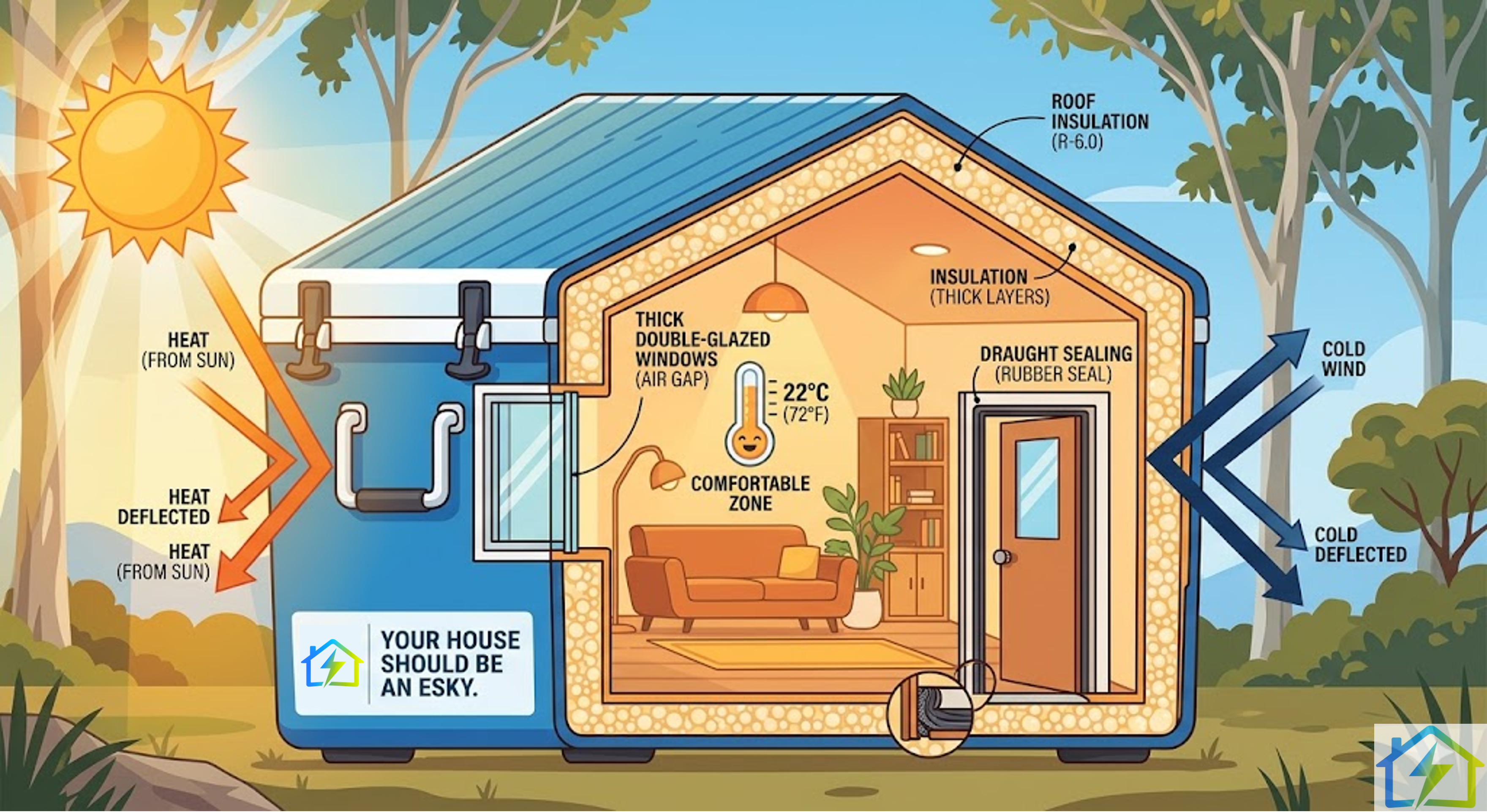
Draught proofing
Sealing gaps around doors, windows, vents, and penetrations to stop unwanted air moving in and out. Unglamorous, cheap, and one of the highest-return efficiency upgrades available. A draughty house is an expensive house to heat. Fix the gaps before you upgrade the heater.
Electrification
The process of replacing appliances that run on gas or other fossil fuels with efficient electric alternatives. Hot water, space heating, cooking, and transport are the main areas. The goal isn’t just environmental — in most Australian households, switching from gas to efficient electric appliances reduces running costs, particularly as gas prices continue to rise.
EVSE (Electric Vehicle Supply Equipment)
The technical term for EV charging equipment — everything from a basic wall outlet adaptor to a dedicated home wall connector to a public fast charger. Often used interchangeably with “charger” even though, strictly speaking, the charger is inside the car. When someone says “home EVSE” they mean the wall-mounted unit in your garage.
Feed-in tariff (FiT)
The rate your electricity retailer pays for solar power you export to the grid. Rates have dropped sharply over the years. In ACT, check your current retailer rate before assuming export is the best use of your solar — in most cases, using or storing the power yourself is worth significantly more.
📋 What’s a FiT? A feed-in tariff is a per-kWh credit for solar energy your home doesn’t use and sends back to the grid. Early adopters locked in generous rates (some as high as 60c/kWh). Today, most ACT households receive 5–10c/kWh — which is a big part of why home batteries have become more attractive. Storing solar and using it later beats exporting it cheap and buying it back expensive.
Heat pump
A device that moves heat from one place to another rather than generating it directly — which is why it’s so efficient. You already own one: your refrigerator is a heat pump. It moves heat from inside the fridge to the coils at the back. A heat pump hot water system does the same thing in reverse — it pulls heat from the outside air and uses it to heat your water tank. A reverse cycle air conditioner is also a heat pump. The same principle, applied to your whole house.
Because they move heat rather than create it, heat pumps are typically 3–4 times more efficient than resistive electric heaters or conventional electric hot water systems. That efficiency gap is why electrification done properly is cheaper to run than gas, not more expensive.
Hybrid inverter
An inverter that manages both your solar panels and a home battery at the same time. If you’re planning to add a battery at any point — even years from now — a hybrid inverter installed from day one saves you money and hassle later. A standard string inverter can’t do this job, and swapping it out later costs more than getting the right one upfront.
📋 What’s a hybrid inverter? A hybrid inverter connects to both your solar panels and your battery. It manages energy flow between the panels, battery, home, and grid. A standard string inverter only handles the panels-to-home-to-grid direction — it can’t charge or manage a battery. Getting a standard inverter when you plan to add a battery later is like roughing in a bathroom without plumbing and being surprised when it costs double to fix.
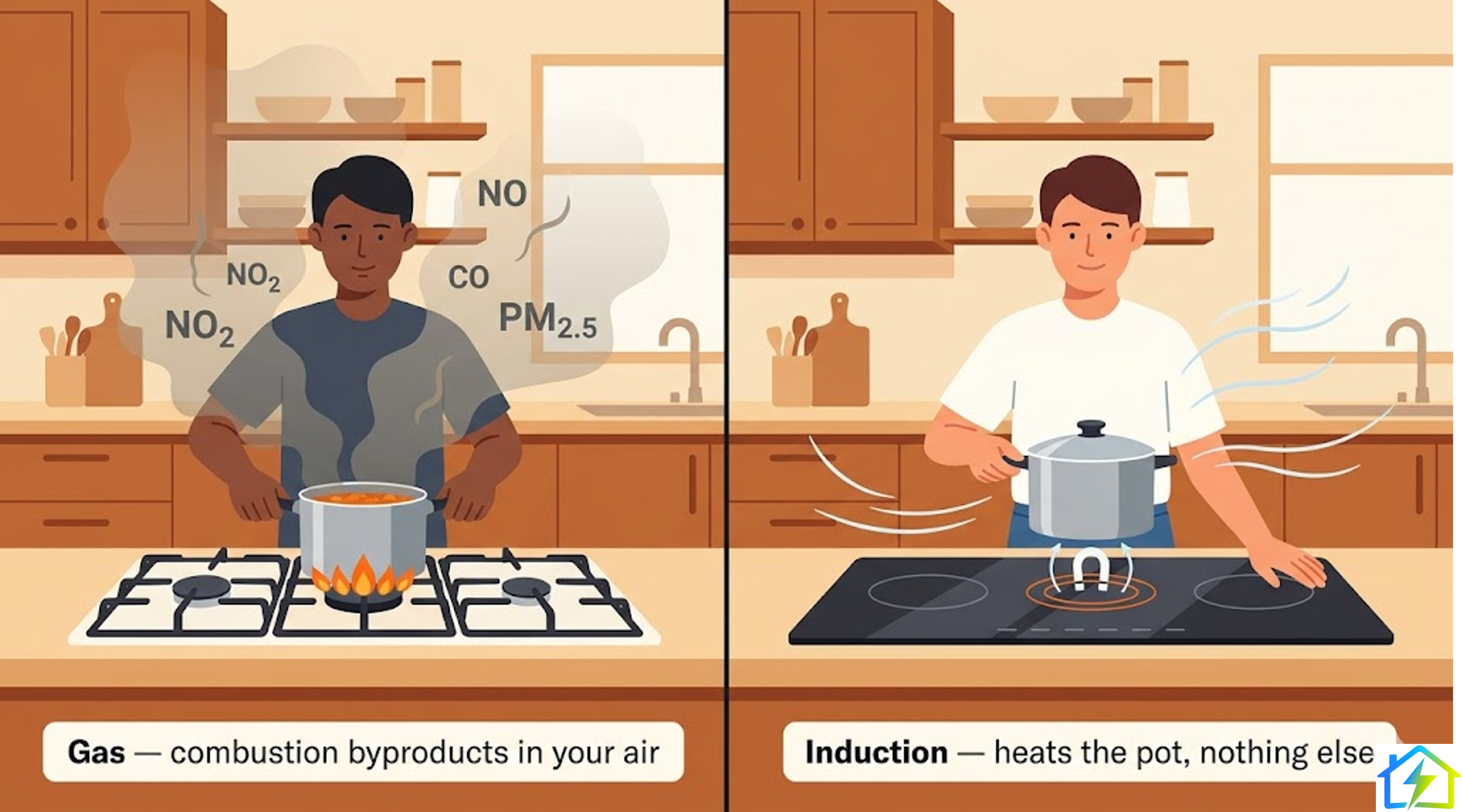
Induction cooktop
A stovetop that uses a magnetic field to heat the pot or pan directly — the cooktop surface itself barely gets warm. Faster than gas, more efficient than traditional electric, easier to clean, and safer (no open flame, no combustion, no gas leak risk). The main barrier is that it only works with magnetic cookware (cast iron and most stainless steel are fine; copper and some aluminium aren’t). For anyone on gas cooking, switching to induction is one of the easier and faster-payback electrification steps.
Inverter
The box on your garage or laundry wall that converts DC electricity from your solar panels into AC electricity your home can use. Without it, your solar system does nothing useful. The inverter is also where most system monitoring data comes from.
Level 1 / Level 2 / DC fast charging
Three tiers of EV charging speed:
- Level 1 — a standard 10A household outlet. Around 10 km of range per hour. Fine for topping up overnight if you don’t drive much.
- Level 2 — a dedicated wall connector (7–22 kW). Around 30–80 km of range per hour. What most homes install.
- DC fast charging — public stations (25–350 kW+). Can charge to 80% in 20–30 minutes. Not for home use; for long trips or quick top-ups on the road.
LFP / LiFePO4 (Lithium Iron Phosphate)
The most common battery chemistry in home storage systems. Praised for safety, long cycle life, and thermal stability. Less likely to overheat than older lithium chemistries. Most reputable home batteries on the Australian market today use LFP.
Microinverter
A small inverter mounted under each individual solar panel rather than one central unit for the whole array. Each panel operates independently, so shading or a fault on one panel doesn’t drag down the others. More expensive upfront, but useful for complex roofs or significant shading.
MPPT (Maximum Power Point Tracker)
The component inside an inverter that constantly adjusts to squeeze maximum output from your panels under changing conditions — cloud cover, temperature, shading, time of day. More MPPTs gives more flexibility, especially on roofs with panels facing different directions or on split arrays.
NMC (Nickel Manganese Cobalt)
A battery chemistry with high energy density — common in EVs where space and weight matter. Less thermally stable than LFP under high heat, which is why LFP has become the preferred chemistry for home storage in the Australian climate.
NMI (National Metering Identifier)
The unique ID number for your home’s electricity meter. You’ll need it when switching retailers, applying for rebates, or getting a new solar or battery system connected. It’s printed on your electricity bill — usually near the top.
Nameplate capacity vs usable capacity
The nameplate capacity is what’s printed on the battery box. The usable capacity is what you actually get access to. Manufacturers hold back 10–20% to protect battery life. A “13.5 kWh” battery might deliver 13.5 kWh usable — or it might not. Always check the spec sheet, not the marketing brochure.
Onboard charger (EV)
The converter inside your EV that takes AC power from a wall connector or outlet and converts it to DC for the battery. The onboard charger sets the ceiling on how fast your car can charge on AC — so even if you install a 22 kW wall connector, a car with a 7 kW onboard charger will only ever draw 7 kW. DC fast charging bypasses the onboard charger entirely, which is why it’s so much faster.
PV / Photovoltaic
The technical name for solar panels that generate electricity from sunlight. PV stands for photovoltaic. You’ll see it on quotes, permits, and rebate paperwork. You never need to say it out loud, but now you’ll know what it means when you do.
R-value
The measure of how well insulation resists heat flow. Higher is better. Relevant for walls, ceilings, and windows. In Canberra, ceiling insulation R-value is one of the more impactful variables in how much it costs to heat your home in winter. Worth checking before you upgrade your heating system — a better-insulated home needs a smaller, cheaper system to run.
Racking / Mounting
The aluminium framework that bolts your solar panels to your roof. Not glamorous, but important — cheap racking is one of the places installers cut costs quietly, and it’s what keeps your panels in place through a Canberra hailstorm or high wind event.
Resistive heating
Conventional electric heaters that generate heat directly from electricity — bar heaters, older panel heaters, and standard electric hot water systems all work this way. They convert 1 kWh of electricity into 1 kWh of heat, no more. A heat pump produces 3–4 kWh of heat for the same input. Resistive heating isn’t wrong — it’s just expensive compared to the alternative.
Reverse cycle air conditioning
An electric air conditioner that can both cool in summer and heat in winter. It uses heat pump technology — the same principle as a heat pump hot water system, applied to your living space. The most efficient form of electric space heating available for most Australian homes. If someone is still heating with gas ducted heating or resistive electric heaters, switching to reverse cycle is one of the higher-impact changes they can make.
Round-trip efficiency
The percentage of energy you get back out of a battery compared to what went in. A battery with 90% round-trip efficiency returns 9 kWh for every 10 kWh used to charge it. The rest is lost as heat. Better efficiency means more of your solar actually ends up being used.
SAA (Solar Accreditation Australia)
The body that accredits solar and battery installers in Australia. An installer needs SAA accreditation for your system to be eligible for STCs (the federal rebate). Always confirm your installer is accredited before signing a contract.
Self-consumption
Using your solar energy inside your home as it’s generated, rather than exporting it to the grid. Self-consumption is worth significantly more than exporting — you avoid paying the import rate (typically 25–35c/kWh) rather than earning the export rate (typically 5–10c/kWh). Shifting usage to daytime or adding a battery both increase self-consumption.
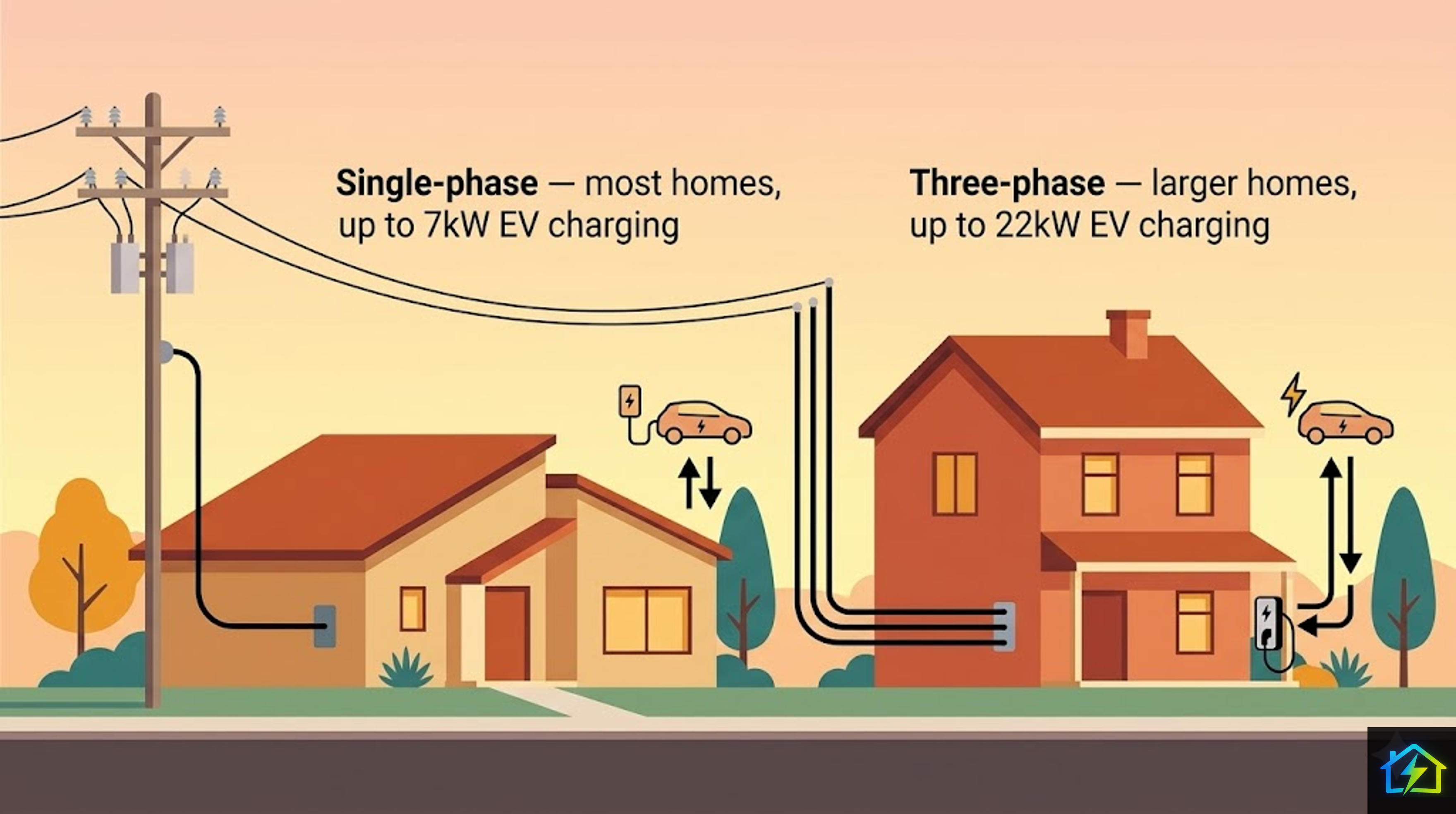
Single-phase vs three-phase
Most Australian homes are connected to the grid on a single-phase supply — one live wire delivering power to the property. Some larger or newer homes have three-phase supply, using three live wires and delivering more capacity. It matters for batteries, EV chargers, and large appliances — some equipment requires three-phase, and solar and battery behaviour can differ depending on which you have. Worth checking before you get quotes.
Smart charging
EV charging that automatically adjusts based on electricity prices, solar availability, or grid demand — rather than just drawing maximum power the moment you plug in. A smart charger might wait until off-peak rates kick in at 11pm, or prioritise charging from your solar during the day. Saves money with minimal effort once it’s set up.
SRES (Small-scale Renewable Energy Scheme)
The federal government program that generates the STCs used to discount solar and battery installations. Most homeowners only ever encounter the STC (the point-of-sale discount) — the SRES is the policy machinery running behind it.
STC (Small-scale Technology Certificate)
The main federal rebate for solar and batteries, delivered as an upfront discount at purchase. Your installer claims the STCs on your behalf and passes the value back as a reduction in your invoice. The discount depends on system size and location. Note: STC also stands for Standard Test Conditions — the lab environment used to rate panel output. Same acronym, two different meanings. Yes, really.
Star rating
The energy efficiency rating displayed on appliances and new homes — more stars means lower running costs. Used across air conditioners, hot water systems, fridges, and washing machines. The rating gives you a quick comparison between models without having to dig into spec sheets. For heating and cooling, always check the star rating for the relevant season (heating stars for Canberra winters matter more than cooling stars).
State of charge (SoC)
The EV equivalent of a fuel gauge — the remaining battery energy expressed as a percentage. Also used for home batteries. 100% SoC means fully charged; 20% SoC means nearly empty. Most systems let you set minimum and maximum SoC limits to protect battery life.
String inverter
The standard central inverter where all panels are wired together in a series. Common, reliable, and cost-effective. The main limitation is that if one panel underperforms due to shade, dirt, or a fault, it can reduce the output of the whole string. Fine for simple, unshaded roofs.
Sustainable Household Scheme (ACT)
An ACT Government program providing low-interest loans to help ACT residents install energy-efficient upgrades — including solar, batteries, heat pumps, double glazing, and insulation. If you’re in Canberra and considering any of these upgrades, check this scheme before you pay full price. The terms and available products change periodically, so verify current conditions directly with the ACT Government or via the Bright Sparks ACT resources page.
Temperature coefficient
A percentage showing how much output a solar panel loses as it heats up. Panels are lab-tested at 25°C — but on a hot Canberra summer day, your roof surface can hit 70°C or more. A panel with a low temperature coefficient loses less power in the heat. Worth checking on spec sheets, particularly for a climate with genuine summers.
Throughput warranty
Many batteries are warrantied on total lifetime energy cycled through them (e.g. 30,000 kWh total), not just years. Cycle a battery hard every single day and you can exhaust the throughput warranty well before the calendar warranty runs out. Check both numbers before you sign.
Throttling
A catch-all term for when your solar system’s output is deliberately or automatically reduced. Two main causes:
- Derating: The inverter protecting itself from overheating on a hot day. It quietly reduces output without triggering a fault — your system just produces less than expected on what should be a peak solar day.
- Network curtailment: Your DNSP remotely limits or switches off your solar exports because the local grid can’t absorb any more power at that moment. More common than most people realise in areas with high solar penetration. You’re generating power — and it’s going nowhere.
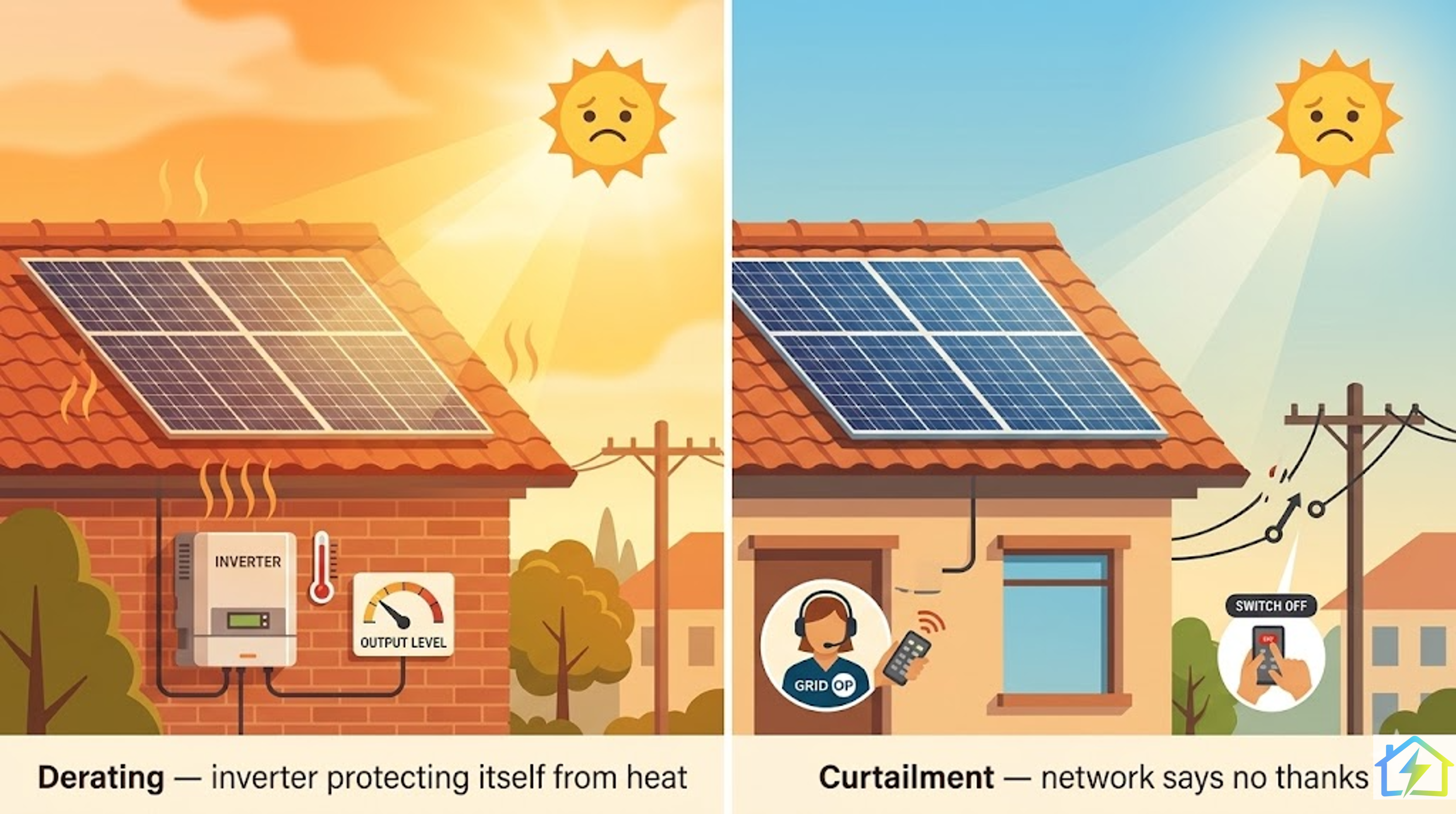
Both problems are significantly reduced by having a battery. Store the excess instead of trying to export it, and curtailment barely affects you.
📋 What’s a DNSP? DNSP stands for Distribution Network Service Provider — the company that owns and operates the poles and wires in your area. In ACT, that’s Evoenergy. They set the rules for how much solar can be exported in your street, and they can remotely limit or switch off your solar export if the network is under strain. They are not your electricity retailer.
Tier 1
A manufacturer ranking from Bloomberg that measures financial stability — whether the company is likely to still exist in 20 years to honour a warranty. It does not measure panel quality. It’s widely used by installers as a quality shorthand, and it isn’t one. A Tier 1 panel from a financially stable manufacturer can still be a mediocre panel. Ask for the performance warranty and degradation rate instead.
Time-of-use (TOU) tariff
An electricity plan where the price per kWh changes by time of day. Peak periods (usually evenings) cost more; off-peak periods (overnight or shoulder) cost less. A battery lets you charge during cheap periods and use stored power during expensive ones — which is where a significant chunk of the battery payback case comes from in ACT.
Type 2 connector
The standard AC charging plug used in Australia for home and public EV charging. What your wall connector uses. What public AC chargers use. If you’re buying an EV in Australia, it will have a Type 2 AC inlet as standard.
V2H (Vehicle-to-Home)
Using your EV’s battery to power your whole home — routing stored energy from the car through your switchboard to run appliances, lights, and heating. More capable than V2L (which only runs individual devices) and more immediately practical for most households than V2G. Requires a compatible EV and a bidirectional charger. Effectively turns your EV into a very large home battery.
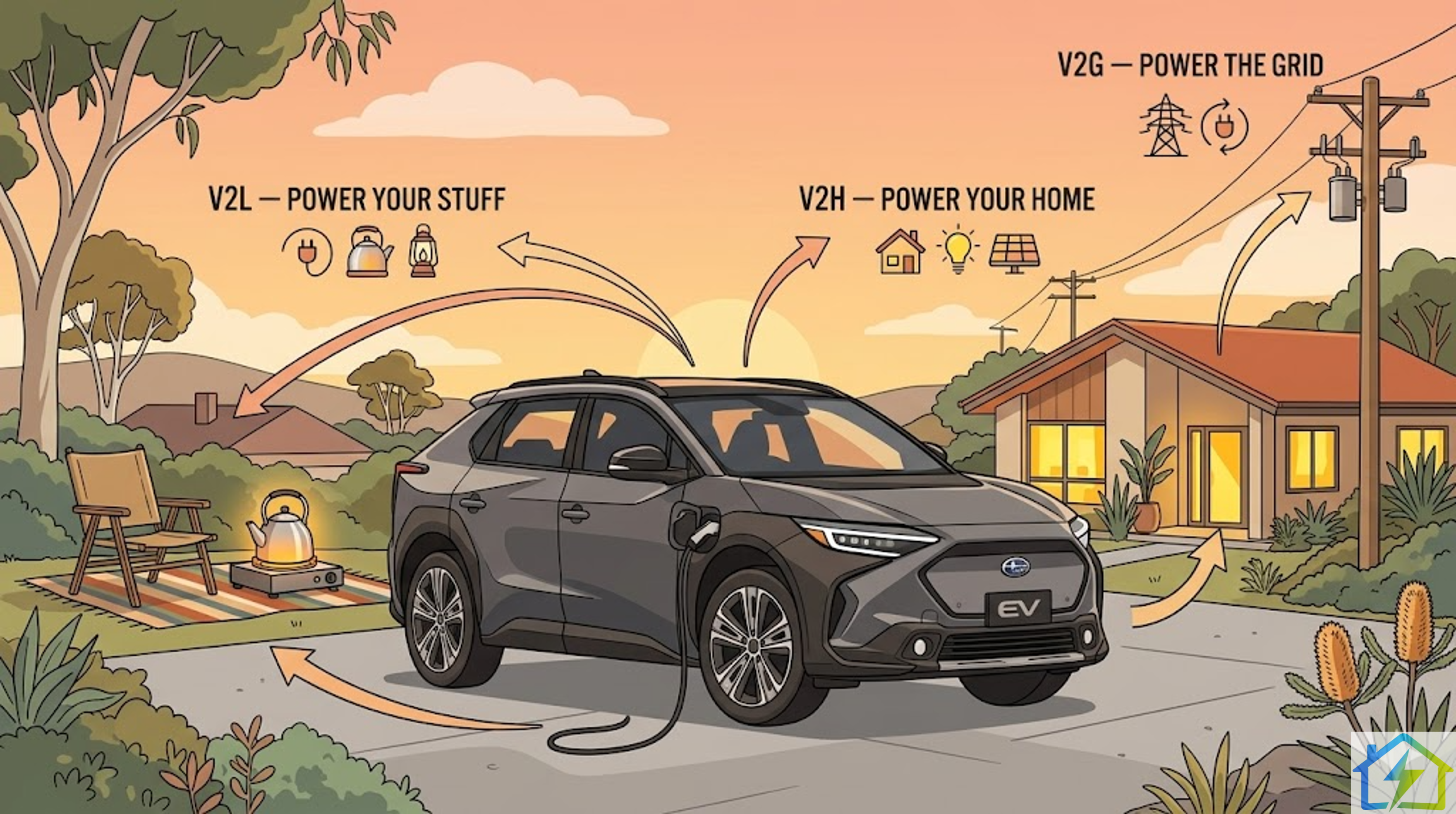
V2L, V2G, V2H — and V2X
V2X is the umbrella term for all “vehicle-to-everything” technologies. The X stands in for whatever the car is powering:
- V2L (Vehicle-to-Load): Power individual appliances directly from the car via an adaptor in the charge port. Camping, worksites, keeping the fridge running in a blackout.
- V2H (Vehicle-to-Home): Power your whole home from the car battery via your switchboard.
- V2G (Vehicle-to-Grid): Feed power back into the electricity grid. Still rare in Australia but the infrastructure is developing — some vehicles and chargers are already capable.
Not all EVs support all three. Check the spec sheet for your model before assuming.
VPP (Virtual Power Plant)
A network of home batteries coordinated by an energy retailer or aggregator to act as a single large power source. When the grid is under stress, the operator draws on all those batteries at once. Homeowners who join typically receive a financial benefit — bill credits, lower rates, or payments. The trade-off is reduced control over your own battery during grid events. Your battery might not be full when you want it. Read the fine print before signing up.
Wall connector (EV charging)
The dedicated unit mounted on your garage or exterior wall for charging your EV at home. Often called a “home charger” — but it doesn’t store or generate power. It controls the flow of AC electricity from your home’s circuit to the car. The actual charging happens inside the vehicle via the onboard charger. Output is typically 7–22 kW depending on the unit and your home’s electrical supply.
More questions?
This glossary covers the terms that come up most often in a first conversation with a client. If something’s still unclear, or you’ve been handed a quote full of terms that aren’t here, get in touch. That’s exactly what Bright Sparks is here for.
Want personalised advice?
Get a free energy review tailored to your home — no products, no commissions.
Get free review