
Do I Really Need Three Phase?
Most people don’t think about their electrical supply until someone tells them they need to upgrade it. That someone is usually an installer quoting you a charger or a battery — and the phrase “you’ll probably want three phase for that” has a funny way of appearing in conversations that involve a comma and five figures.
So let’s look at what three phase actually gets you, when it matters, and when it doesn’t.
What’s the difference?
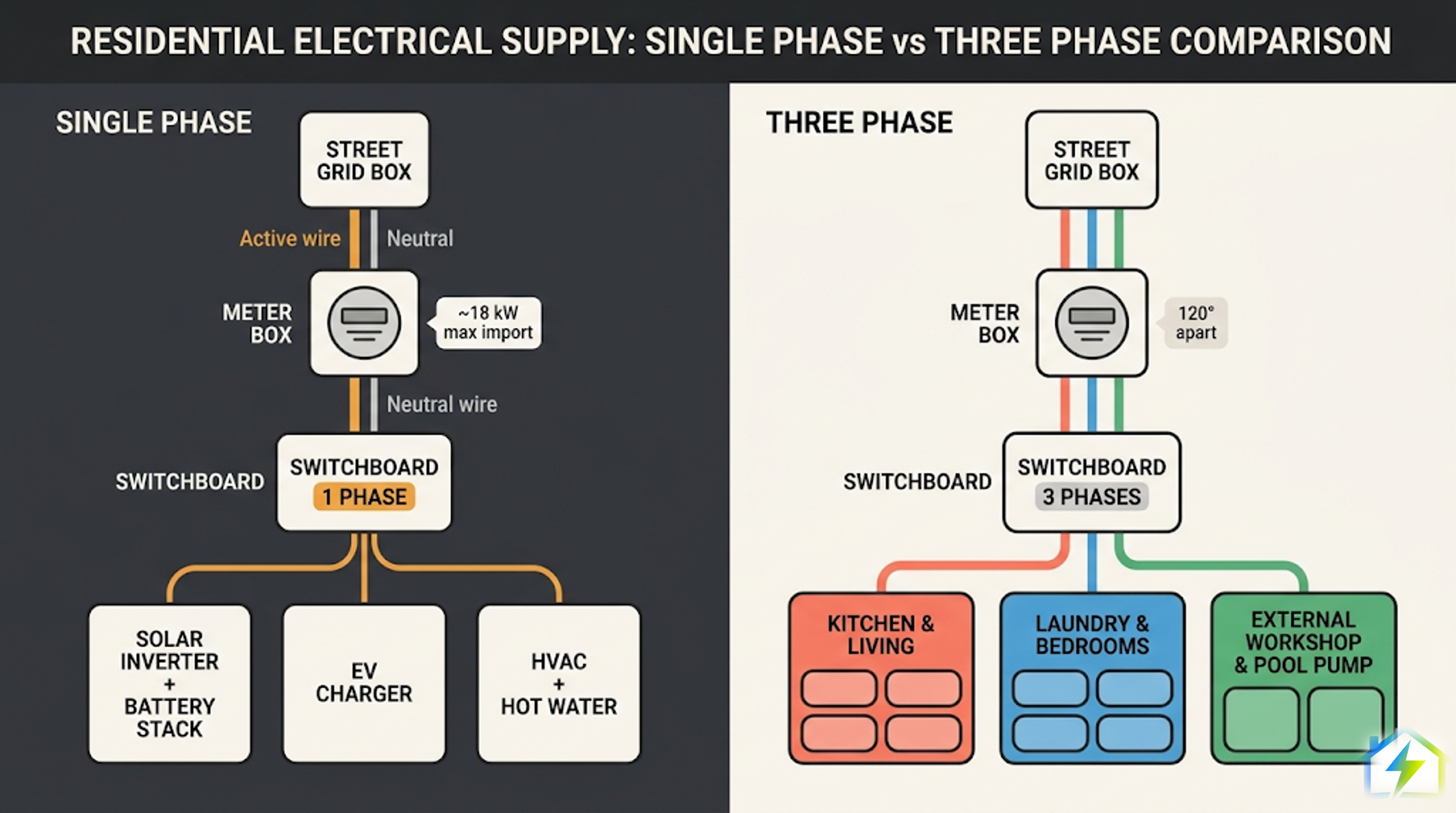
Single phase is the standard residential supply in most Australian homes. You get one active conductor and a neutral. Everything runs off it: your lights, appliances, solar inverter, battery, hot water system, EV charger.
Three phase gives you three active conductors — each running at a different point in the AC cycle. The big practical benefit is that three-phase appliances and chargers can draw power across all three phases simultaneously, which allows for higher continuous power draw without overloading any single conductor.
📋 What’s “three phase”?
The electricity grid delivers AC power in a sine wave — voltage rising and falling 50 times per second. Three-phase power has three of these waves, each offset by 120 degrees. Large commercial and industrial sites use three phase because it allows much higher sustained power draw. Most Australian homes are single phase. Three-phase supply is available in most streets, but getting it connected to your property involves a DNSP application, a licensed electrician, and typically $2,000–$5,000+ depending on your meter box and what the network charges for the connection.
The EV charger pitch
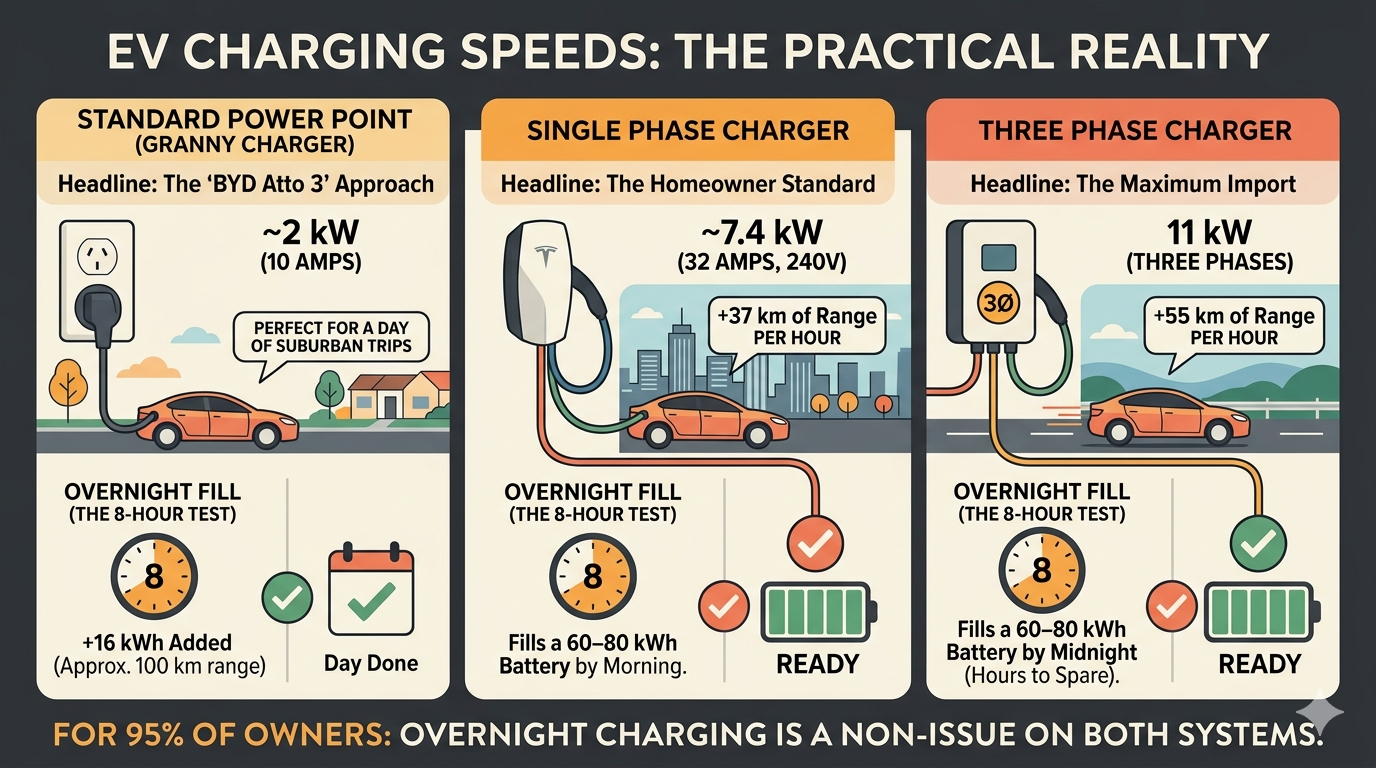
This is where most homeowners first hear the three-phase pitch. An EV charger on single phase tops out at around 7.4 kW (32A on a 240V supply). A three-phase charger can go up to 11 kW (three phases × roughly 3.7 kW each) or beyond.
In practice: how often do you actually need 11 kW versus 7.4 kW?
A 7.4 kW charger adds roughly 37 km of range per hour of charging. An 11 kW charger adds roughly 55 km per hour. If you plug in overnight — which most people do — the difference between the two is irrelevant. Either will fill a 60–80 kWh battery from near-empty by morning with hours to spare.
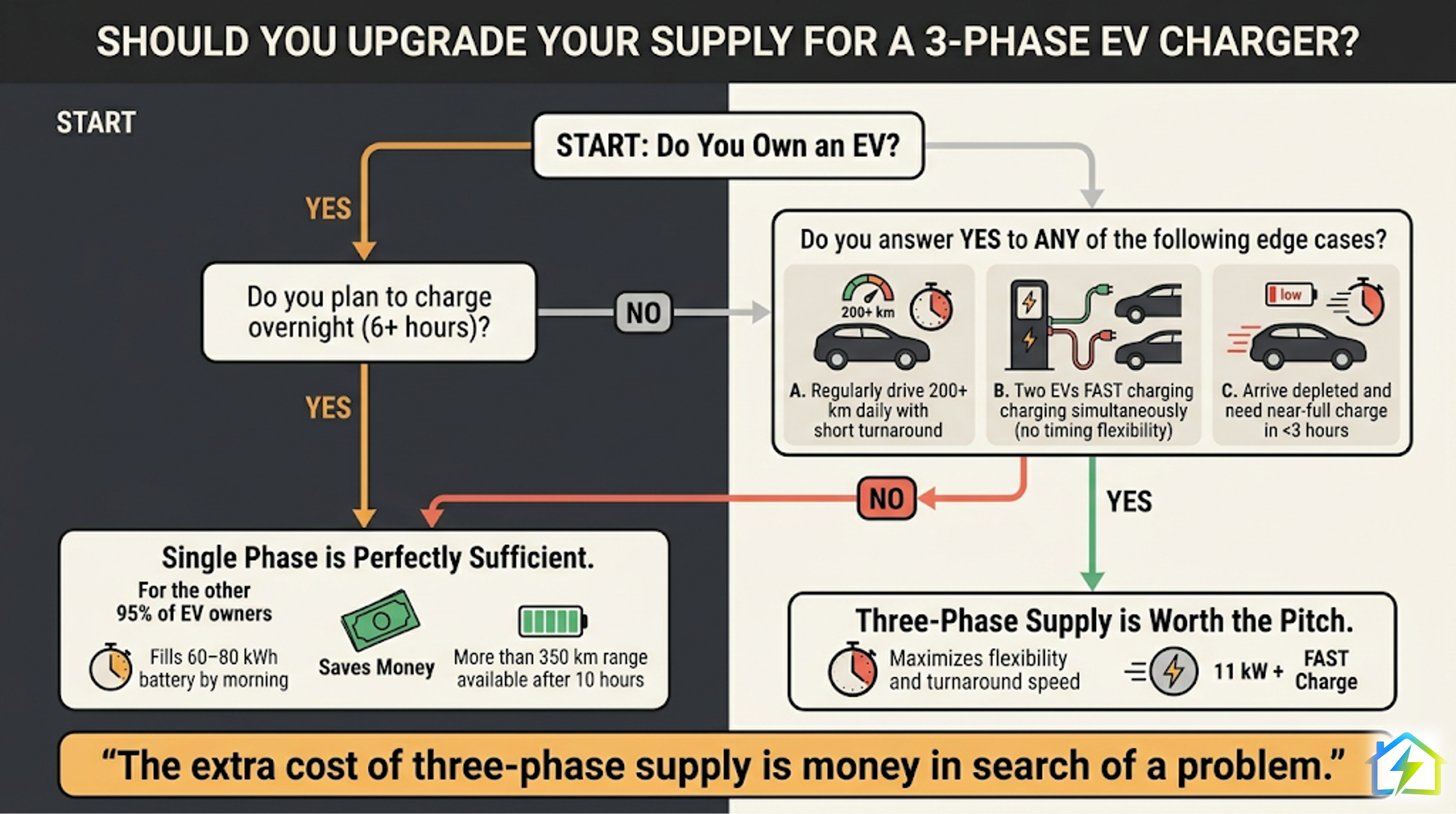
The genuine cases where 11 kW earns its keep:
- You regularly arrive home with a depleted battery and need the car charged and ready within a few hours
- You have two EVs both needing fast charging simultaneously, with no flexibility on timing
- You drive very high daily distances (200+ km) and need maximum flexibility on short turnaround For the other 95% of EV owners: the extra cost of three-phase supply to unlock 11 kW is money in search of a problem.
We have two EVs. The Tesla Long Range goes on the 7 kW wall connector. The BYD Atto 3 — which does most of its driving around town — goes on a 10A granny charger. That’s 2 kW from a standard power point. The Atto 3’s battery is around 42 kWh usable. Eight hours on the granny charger puts back 16 kWh — more than enough to cover a day’s worth of suburban trips. No dedicated charger. No three phase. No drama.
What about batteries?
Same logic applies. Most residential battery systems — including the popular 10–15 kWh units common in ACT installs — specify a maximum charge and discharge rate. A 10 kWh battery with a 5 kW inverter is fully charged in two hours. It doesn’t need three-phase supply to do that.
Some larger battery systems do support three-phase inverters, and if you have a three-phase home already, a three-phase battery system can balance loads better across your circuits. But if you’re starting from scratch on single phase, the battery doesn’t change the equation.
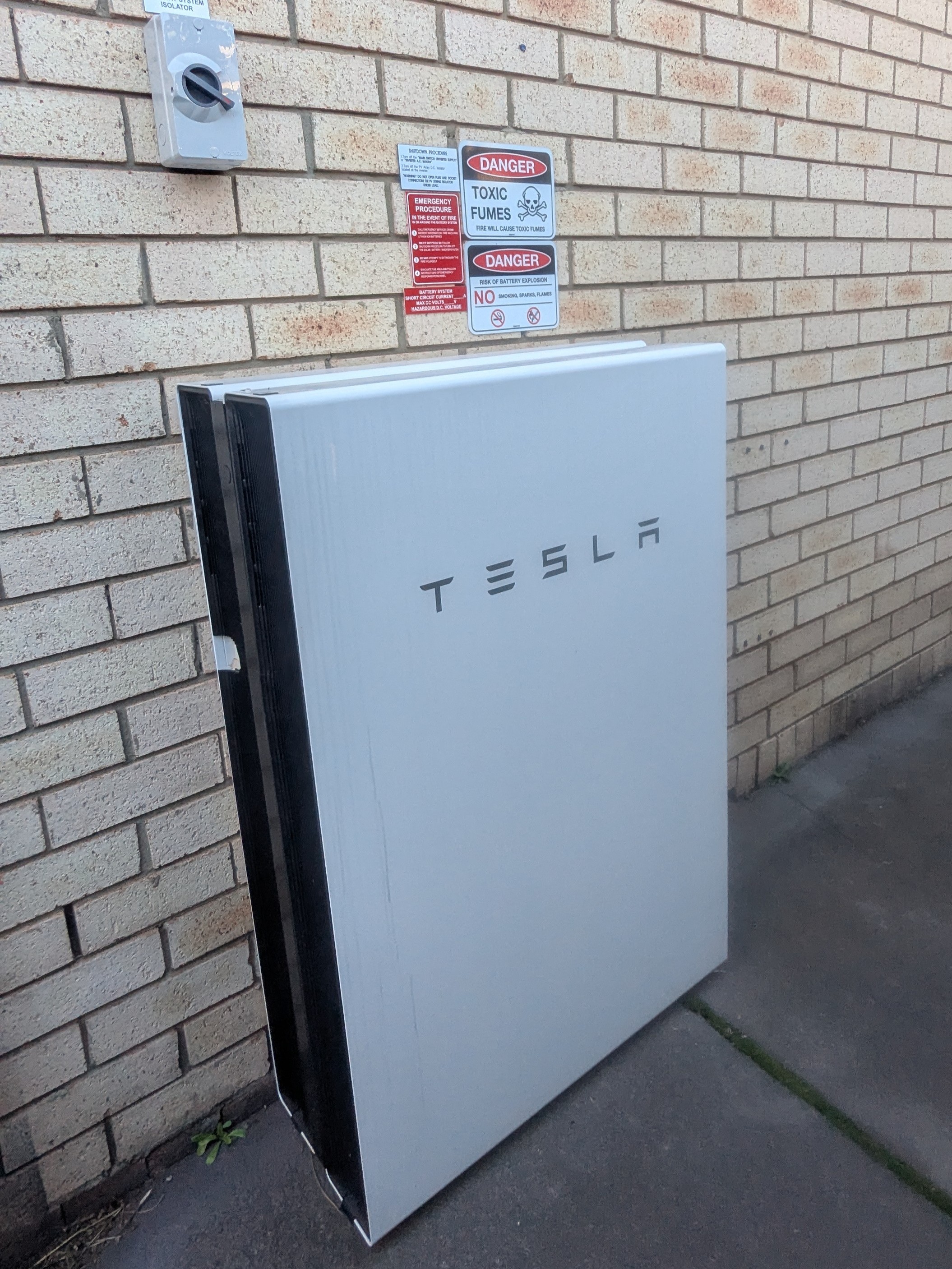
My own setup has two Tesla Powerwall 2s — 27 kWh of usable storage, 10 kW in and out. During the day, when the ducted HVAC and induction cooktop are running at the same time, the Powerwalls smooth the peaks without the grid even noticing. The single-phase supply isn’t the constraint. The batteries are doing their job.
Can the rest of the house still work on three phase?
Yes, and this is worth understanding properly. Three-phase supply doesn’t mean everything in your house runs at three-phase — it means your switchboard distributes load across three phases, and certain appliances can be wired to use all three simultaneously.
A three-phase home is still running most of its circuits on single phase — each circuit is connected to one of the three phases. The advantage is that large single-phase loads (like an EV charger or a ducted air conditioner compressor) can be spread across different phases rather than stacking on one.
So yes, everything still works. The three-phase “upgrade” is mostly about capacity headroom, not compatibility.
The 2am Canberra winter test
Here’s the load stack at my place on a cold winter night — the kind of night that should, in theory, expose every weakness in a single-phase setup.
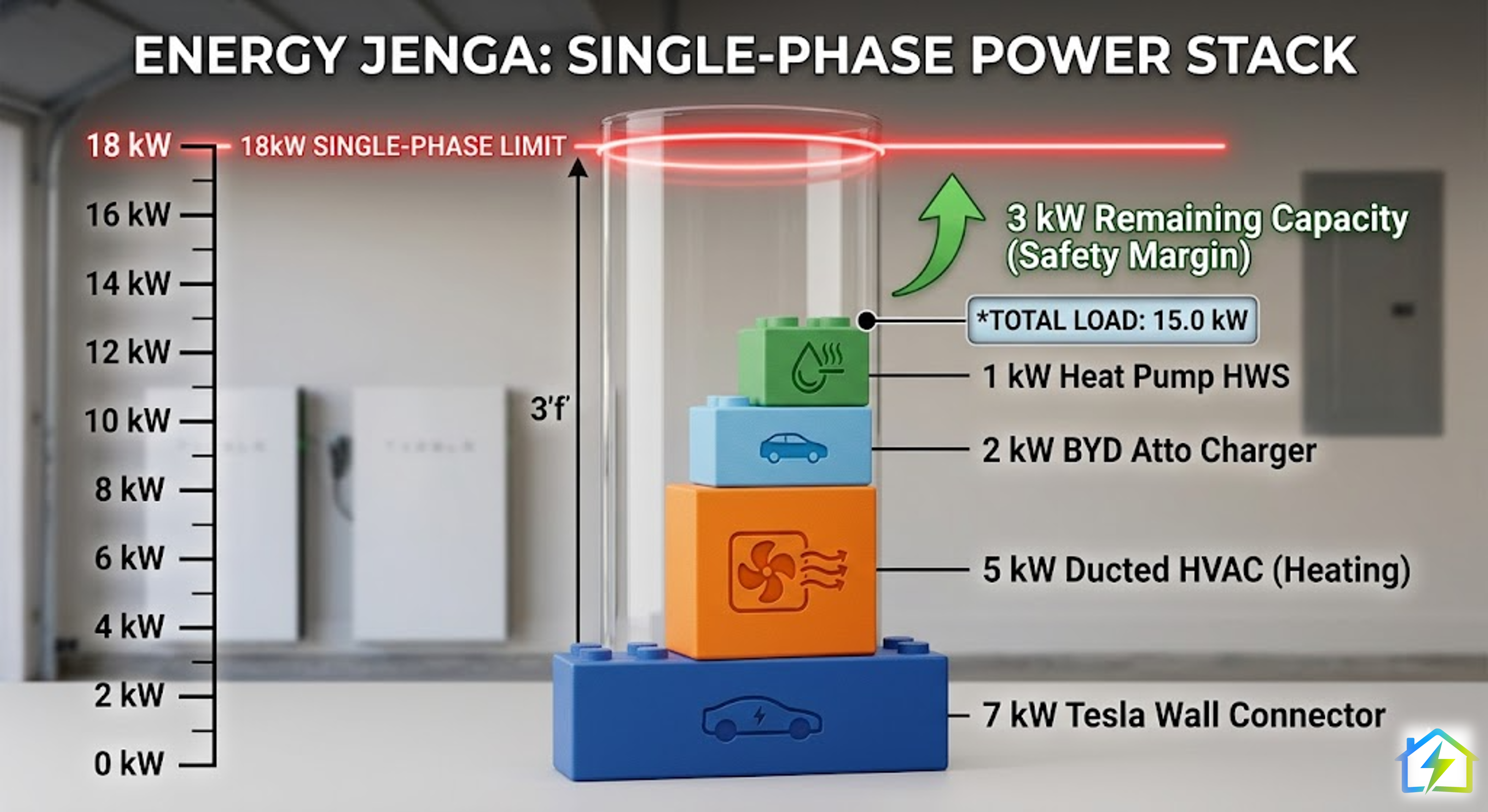
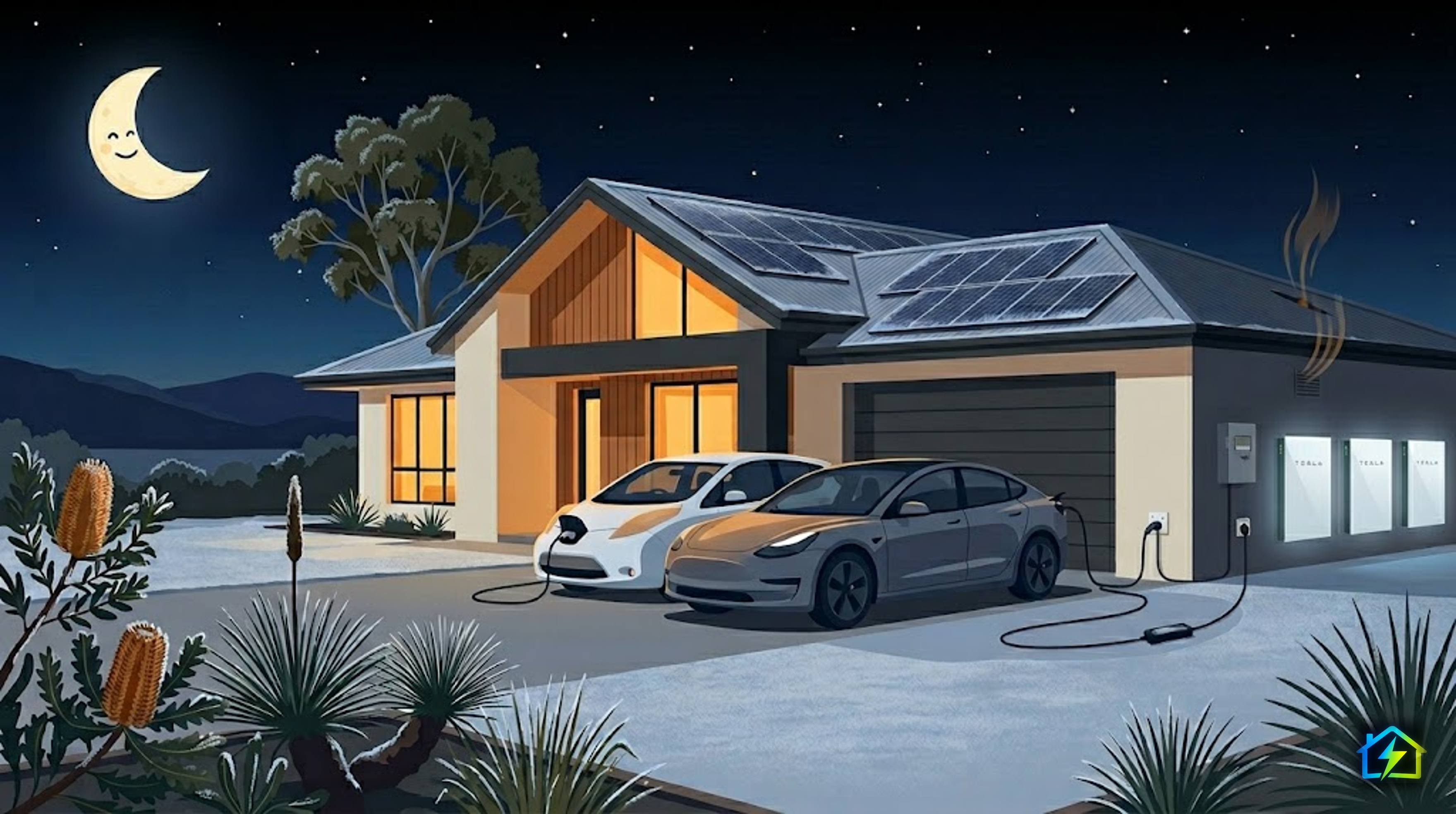
It’s midnight. Outside it’s -4°C. The ducted HVAC is running hard to keep the house warm. The Tesla Long Range is on the 7 kW wall connector, charging on the super off-peak rate (free, in our case). The Atto 3 is ticking along on the granny charger at 2 kW. The heat pump hot water is doing its off-peak cycle.
Total draw: somewhere around 14–16 kW. The grid import limit on a standard single-phase supply in Canberra is around 18 kW. Nothing trips. Nothing queues. The house is warm, both cars are charging, the hot water is sorted, and we’re doing it all on cheap overnight power.
Three phase doesn’t appear anywhere in that equation. What does appear is a time-of-use tariff dialled in to shift loads overnight, and a battery system that handles the daytime peaks so the grid connection doesn’t have to.
That’s the actual answer to “will single phase be enough.”
When three phase actually makes sense
Be honest about this: there are real use cases.
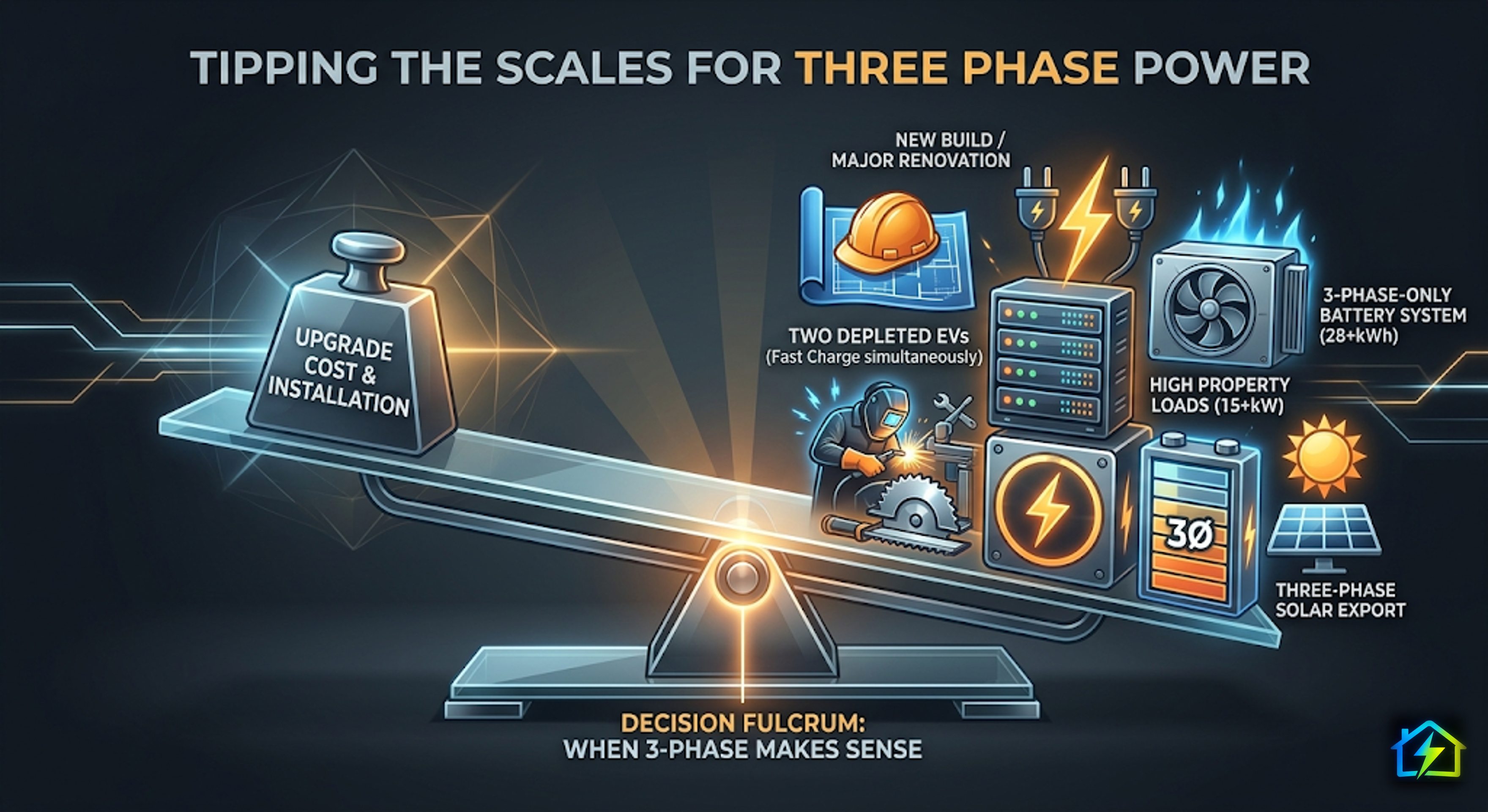
- New build or major renovation — if you’re doing a switchboard replacement anyway and anticipate large future loads (two EVs, large battery, ducted HVAC), three phase at that point is worth considering. The marginal cost is lower when the electrician is already there.
- Two EVs both needing fast charging on short turnaround — if both cars regularly come home depleted and need to be ready in a few hours, a second dedicated charger on single phase starts to eat into available capacity. But if one car is mostly doing short trips and can live on a granny charger overnight, the problem largely disappears.
- Large property with genuinely large loads — workshop, pool, large ducted system, home office with server infrastructure. If your total instantaneous demand regularly hits 15+ kW, three phase gives you headroom.
- Some three-phase-only battery systems — a handful of higher-end or larger battery products require three-phase installation. If you’re sizing up (28+ kWh), check the specs.
- Three-phase solar inverter — if you want to export solar across all three phases for balancing, or your DNSP limits single-phase export, a three-phase inverter is the answer. But this requires three-phase supply first.
What most people are actually told versus what’s actually true
“You’ll need three phase for the EV charger” often means: we have a three-phase charger in our price book and the margin is better.
“Single phase won’t be enough for your setup” often means: I haven’t asked what your setup is.
The honest questions to ask:
- What’s my current peak demand, and will a single-phase supply actually be the limiting factor?
- What daily charging window do I actually have for the EV?
- Am I adding one EV or two?
- Is the installer quoting a single-phase option at all, or only the three-phase path? If they’re not asking those questions before recommending the upgrade, push back.
The Bright Sparks read
Single phase handles a fully electrified home — including battery storage and EV charging — for the overwhelming majority of Australian households. The cases where three phase meaningfully changes the picture are real but narrow.
Three-phase supply costs money to connect, may involve network charges and DNSP approval, and adds complexity to your system. Don’t pay for headroom you won’t use.
If you’re getting a quote that includes a three-phase upgrade and you’re not sure whether it’s justified, that’s exactly the kind of thing a flat-fee review is for.
Next step: Before signing off on a three-phase upgrade, ask the installer to show you the single-phase option and explain specifically why it won’t meet your needs. Watch them squirm.
Bright Sparks Home Energy offers flat-fee quote reviews with no installer relationships or commissions. [Book a review →]

Want personalised advice?
Get a free energy review tailored to your home — no products, no commissions.
Get free review